
On September 1st, 2016, San Francisco 49ers’ quarterback Colin Kaepernick kneeled during the national anthem moments before the kickoff of a preseason game in protest of police brutality and other forms of social injustice in the United States. While the game itself was meaningless, Kaepernick’s decision to kneel challenged the collective consciousness of American citizens, igniting nationwide contentious discourse that encompassed cultural and national identity, institutional racism, and socio-economic inequality in a country where individualism reigns supreme. Athletes have been politically outspoken in the past, such as when Muhammad Ali refused to serve in Vietnam (1967) or when Tommie Smith and John Carlos famously did the Black Power salute at the 1968 Olympics.[i]
However, Kaepernick has spearheaded a more sustained social activist movement of athletes, particularly amongst African Americans, who are using their unprecedented influence and financial resources to redirect attention towards social activism, this time coupled with more corporate backing and a more sentient public. This movement reached a new pinnacle when, on May 25th, 2020, the knee of a cop took the life of 46-year-old George Floyd, inciting Black athletes and their allies to unify, protest, and demand change through collective action. Though athletes across the sports world have banded together in solidarity, no two leagues have taken greater stands against institutional discrimination than the National Basketball Association and the Women’s National Basketball Association, in spite of calls from talking heads, like Laura Ingraham, to “shut up and dribble.”[ii] Players like LeBron James or Maya Moore come to mind when we think of leaders of the basketball community, however, there may perhaps be no greater ambassador to the sport than civil rights hero and eleven-time NBA champion Bill Russell.
In this essay, I will analyze how an op-ed style piece written by Russell, published in The Players Tribune, reflects Catherine Squires’ notion of a black public, operating predominantly as a satellite public sphere and partly as a counterpublic sphere, by subverting, through form and substance, journalistic norms and traditional entertainment ambitions that are inherent to the power structure of the mainstream sports media business. Furthermore, I will dissect how the website’s use of the #BlackLivesMatter theme converges narratives put forth by a myriad of athletes that shed light on racial justice issues in a way that illustrates the concept of hashtag activism, tackled by Jackson, Bailey, and Welles.
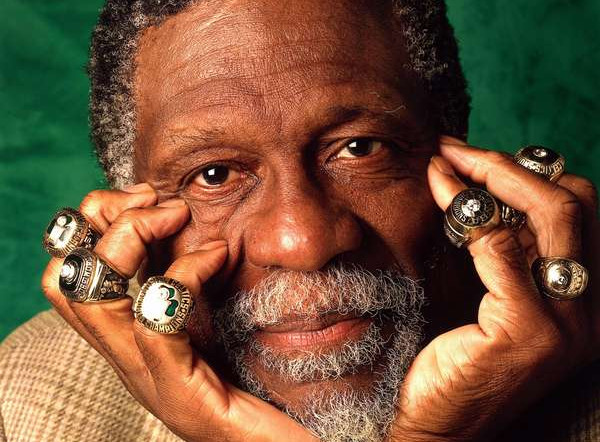
“Racism is Not a Historical Footnote” is a moving piece of storytelling penned by Bill Russell and published on September 14th, 2020 by The Players Tribune, a new media company founded by Yankees legend Derek Jeter in 2014 that provides an outlet for athletes to share unfiltered personal stories catered with minimal help from the editorial team. The content is uniquely created by the athletes, a trend that is becoming increasingly visible across the self-branding social media ecosystem that has redefined the dynamic between players and media members. Russell, a man whose wisdom and status as a Black icon bridges the Jim Crow past with the present, details in formal language how he was subjected to racism, first while living in Louisiana in the 1930s and then in Boston during his tenure with the Celtics.[iii] He insists that America must directly reckon with its racist foundations and its pervasive nature which extends beyond just “a few bad apples,” a common sentiment expressed by many white people. Russell explains that “racial injustice is rampant throughout every sector of American society, from education to health care to sports, and the fact that this remains surprising to many reveals exactly how different Black and white people’s experiences of life in America are.” Russell cites a story about his grandfather shooting at Klansmen until they left running and another one about his father diving off the road into a ditch to avoid a couple white men firing at him from a car. He remarks a paragraph later, “The effects of racial terror perpetrated over hundreds of years don’t disappear simply because America wills them to.”
Russell’s account exemplifies Catherine Squires’ umbrella term of “Black publics” (or marginal publics) developed in her article, “Rethinking the Black Public Sphere,” because the material of his writing, as well as the medium providing him a platform, are a reaction to the exclusionary politics of dominant public spheres and the state.[iv] Squires argues that throughout the course of the Antebellum period, the Reconstruction era, and the civil rights movement, it was imperative, for the sake of political and social advancement, that African Americans create their own public spheres, which she defines as “a set of physical or mediated spaces where people can gather and share information, debate opinions, and tease out their political interests and social needs with other participants.” (Squires, 456) Russell’s written piece is part of a marginal mediated space amongst athletes who share their own testimonies and articulate criticism of dominant publics in politics and sports. For instance, he calls for a “dismantling and rebuilding of our institutions” and a need to end “voter suppression so that everyone can vote for change from the bottom to the top of the ballot.”[v]Moreover, he notes that “the Washington Redskins finally decided to change their name after years of refusing to, despite the repeated requests of indigenous peoples and social justice advocacy groups.”[vi]
The article is located in the “Silence Is Not An Option” category displayed on the website’s navigation bar. When clicked on, its subheading reads: “Athletes are people, too. Listen to their stories. Speak up for what’s right. Silence is not an option. #BlackLivesMatter.” This section of the website is a technological affordance that permits athletes to express and amplify their opinions regarding race relations in the United States, ranging from Misty Copeland’s account of being a black ballet dancer to Bubba Wallace sharing his experience as an African American NASCAR driver who landed in controversy when he spoke out against the confederate flag. The deliberate mention of #BlackLivesMatter as the end of the subheading is indicative of the concept of hashtag activism. As Sarah Jackson, Moya Bailey, and Brooke Foucault Welles explain in their article, “From #Ferguson to #FalconHeights: The Networked Case for Black Lives,” #BlackLivesMatter reveals the ability of decentralized networks to eschew hierarchy to spread messages to diverse groups that reference police violence and share movement tactics.[vii] Bill Russell’s piece complements the larger narratives of the Black Lives Matter movement and takes part in today’s new discourse trends that are reshaping how racial justice issues are being covered in America. Jackson, Bailey, and Welles illustrate how alternative media sources (like The Players Tribune) have become popularized, “The widespread reach and distributed organizing of the various networks taking part in Black Lives Matter discussions online make it possible for many different voices to rise to prominence, which means that no single person or group of people is representative of the whole movement.” The authors further emphasize the need for firsthand, community specific accounts given that state representatives and newsmakers often paint African Americans and their communities, issues, or activism in stereotypical and myopic ways.[viii]
While the website was founded with commercial incentives in mind, the “Silence Is Not An Option” subsection operates partially as a counterpublic that discloses counterhegemonic ideas to wider publics, but mainly as a satellite, defined as “a public that seeks separation from other publics for reasons other than oppressive relations but is involved in wider public discourses from time to time.” (Squires, 448) Until very recently, African American athletes were never afforded a technological medium or vehicle of publicity to speak out on political issues on such a large scale. Traditionally speaking, these athletes had rather constrained relationships with the political, economic, and media institutions of the dominant society that dictated what were the legitimate modes of communicative and cultural expression.[ix] The Players Tribune functions as a satellite by providing a platform for collectives that do not seek consistent discourse or interdependency with publics, like ESPN or CNN, and only overlap intermittently with others if a particular article goes very viral. The website does not feature a comment section, perhaps to preserve the ability for group members to engage in independent spaces without feeling compelled to mince their words.
Why this particular satellite has come to prominence may be attributable to several factors that are integrally tied to power. Michael Serazio, an assistant professor of communication at Boston College, wrote “The Power of Sports: Media and Spectacle in American Culture,” a book that unloads how the sports media industry often fails to balance its journalistic necessities with its entertainment ambitions due to the degree to which business arrangements and structural biases are entrenched in content.[x] Serazio expands, “The noble ideals and myths that inform journalistic ambition on other beats– objectivity, watchdogging power, comforting the afflicted and afflicting the comfortable — do not sound quite so applicable when extracted from more “serious” matters like politics, war, or business. And, yet, sport is big business, as a slew of statistics has already documented, and sport does have major political ramifications” (Serazio, 99).
The choices taken by dominant media publics to steer clear of political engagement, reasoned through a pretense of escapism and community rather than financial risk, turn a deliberate blind eye to the realities of the athletes they are supposed to be covering.[xi] Ironically, American sports blatantly substantiate a capitalist meritocratic ideology glittered by tales of triumphant underdogs who defy all odds, notwithstanding the egregious wealth disparities present in the United States, not to mention the US Department of Defense spending millions of dollars in taxpayer money on marketing contracts with franchises.[xii] Thus, if athletes are not given the ability to speak their mind on political issues that are also personal, it is no wonder why new satellites like The Players Tribune are being sought after, allowing athletes to present themselves on their terms while, in the process, stripping the need for the intermediated journalist.
In Bill Russell’s poignant piece, he soberly laments, “As long as large swaths of Americans regard slavery, Jim Crow and racism as historical footnotes – missteps long since corrected – there is no way to move past racism.” While there is still a ways to go, the capacity to diffuse marginal narratives directly from some of the world’s most influential Black figures enabled by decentralized public spheres is a step in the right direction that America shall properly reconcile with its past in order to move forward. As Jackson, Bailey, and Welles brilliantly point out, Black lives matter, however, so do Black afterlives.
 Elixir Sports