
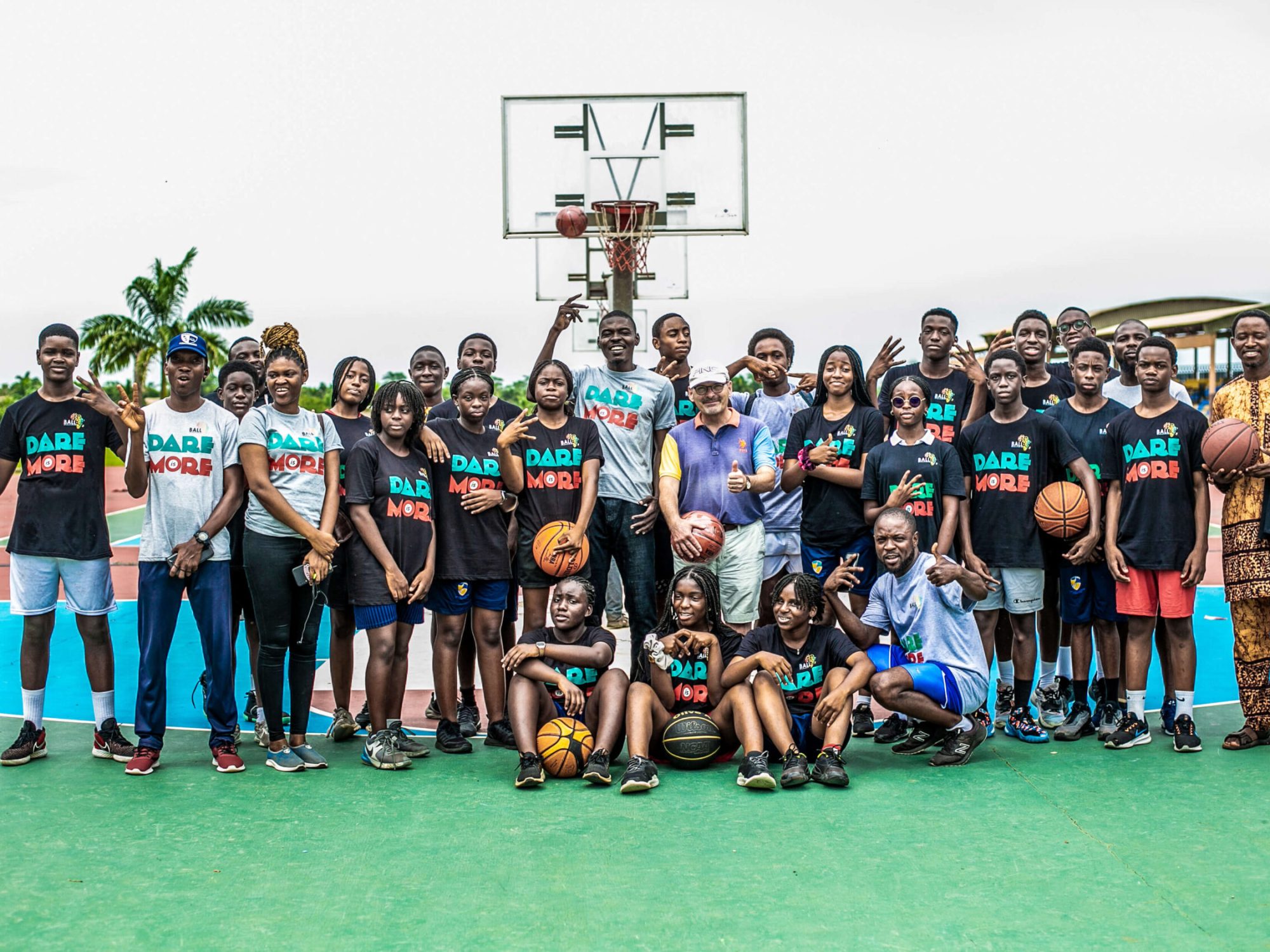
Oluwafemi Adefeso is a Nigerian sports journalist and producer based in Lagos. His non-governmental organization, B.A.L.L Africa, strives to use the power of sport to promote literacy and develop mentorship tools for Africa’s next community of social leaders.
Whether it was leaving his home country for the first time, meeting LeBron James, or spearheading efforts to develop Africa’s sports infrastructure, Oluwafemi’s ongoing journey is marked by his ability to channel his lifelong love for sports for a cause that is bigger than himself.

An early introduction to sports
Femi insists that his obsession with sports was God-given. Coincidentally, a childhood photo that captures his first steps also features a soccer ball and post cake design on his first birthday.
“As a kid, I played football —I played my neighbors, cousins… I have one biological sister, but I have a large extended family, we were always close-knit.”
In addition to playing with his peers, Femi immersed himself into football thanks to the location of his home.
“Where I grew up was just a few miles away from The National Stadium, Lagos. I was close to the stadium, so when the national football men’s team had a big match, you could hear the noise in the stadium right from where we live. I had a neighbor who was a sports journalist as well, the late Fabio Lanipekun. I think I picked up some of those attributes that later would work for me by going to his house, seeing those trophies, watching him on TV. I sort of think there was a rub off as well looking at it [in] hindsight.”
Femi first excelled at football, replacing the goalkeeper of his junior secondary school’s team who could no longer attend practices. However, though he was very much involved with football, Femi stumbled into basketball by participating in a competition called Inter-House sports, a school-wide competition that groups up students into the different houses they get assigned to when admitted to secondary school.
Femi represented the blue house at Babington Macaulay Junior Seminary, which is owned by the Anglican church. “I decided to play basketball as well, and we won a gold medal in my final year of secondary school — what you call your senior year. And that was the first big achievement that I have in regard to basketball competition.”
College experience
Femi initially decided to study physical education in college, focusing heavily on academics rather than his athletic abilities.
“In Africa, a lot of our parents would really push you to get good grades so you could become a doctor, a lawyer, the white-collar jobs and all that. I just forgot about sports my first year, I was focused on getting great grades at university. So for the first year, I didn’t really take sports seriously.”
Femi then received some valuable advice from a professor who encouraged him to also compete.
“You can’t be a student of this department and the school wants you to go for a competition, and you would be a part of the team, your talent should be displayed.”
“I went to the school sports center, and I had two options: either to become the school goalkeeper for soccer or go to the basketball court and play basketball. I ended up going to the basketball court because I felt I wouldn’t have to throw myself on the floor.”
“After the first practice, the coach was like, ‘Hey young man, where have you been?’ And I’m like, ‘Well, I’m in school.’ And he was like, ‘I will see you in practice tomorrow.’”
Femi made the team after the first practice and his team ended up in the finals, coming in second. Shortly after, he was selected by the state’s sports association to take part in the National Sports Festival, a country-wide competition comprised of young athletes representing their states.
The experience provided Femi validation about his basketball talents, though it also led him to some insights about the need to develop the country’s youth sports infrastructure.
“One of the problems that I’m trying to solve with my non-profit is introducing [organized] sports to kids. As much as I played very early, I wasn’t introduced to organized sports very early, so I did not develop myself well enough of to be good, to go professional. Maybe I would’ve gone through another route, maybe instead of going to college in Nigeria, I’d have perhaps looked for a scholarship to come to [the] USA. But because of my age, that was out of the question for me, I was much older at the time. I tried to join an academy in Nigeria, a local club, I played some national tournaments, I represented my state, and I played pretty well.
After playing for a couple of years, professional opportunities were hard to come by and Femi understood that continuing to pursue those ambitions would require a ton of sacrifice.
“I talked to myself, ‘what else can I use my passion for sports for?’ Because I wouldn’t just be useful in another space, and I never saw myself sitting in front of an office desk — it just wasn’t for me.”
Early media career
After completing his first degree, Femi decided to pursue a major in broadcasting and eventually received a Post Graduate diploma in Mass Communication from the Nigeria Institute of Journalism. Because soccer was huge in the country, Femi decided to pave his lane in basketball, as it wasn’t as popular at the time.
“I know my way around basketball, I’ve been to a few tournaments here in Nigeria. I played The Festival, so I know a lot of the coaches, players, opponents, teammates. I already had a network of some sort, so it made sense for me.”
While in journalism school, Femi decided to volunteer at a community radio station, UNILAG 103.1fm. One of his first tasks was to take his first trip outside of Nigeria in 2013 and cover the national team at the African championships in Cote d’Ivoire.
“Two-day road trip, perhaps the riskiest thing I’ve done in my entire life.”
Femi spoke no French and had to pay for his trip out-of-pocket due to his volunteer status. However, this experience would prove to be the most consequential decision of his young career.
“I ended up going on that trip. I covered the national team —we lost at the quarter finals to Senegal, it was a bad tournament. I came back home, then, with all my knowledge, I began to be a resource for basketball in the country, so all the TV networks knew I was there. When I came back, they really wanted my take on how the team performed, insight, etc. So major networks called me and that sort of gave me my first break into prominence with the local networks here, TV, radio.”
“Before I knew it, one of the major networks gave me a segment on the primetime TV every week. I did a basketball update for 15 minutes for the local scene, the international scene—and I did that for almost four years.”
How meeting LeBron James inspired Femi to start B.A.L.L. Africa
Over the course of those four years, Femi traveled across the continent to cover basketball in countries such as, Tunisia, Morocco, Mali, Cote d’Ivoire, Ghana, and Benin.
In 2018, however, Femi received a once-in-a-lifetime opportunity: to cover the NBA in Los Angeles during All-Star weekend, as well as regular season games in Chicago and Indiana. Femi landed an interview with Nigerian NBA star Victor Oladipo, but the true highlight was interviewing the face of the league, LeBron James.
Femi had a powerful realization. “It dawned on me the night I interviewed LeBron. [After] sleeping I woke up and I realized, ‘Hey, I actually interviewed LeBron James! I’m still living the dream, but I’m living the dream from a different route.”
“It occurred to me that I need to get this message back home to encourage the kids not to give up on their dreams of sports. Even if you cannot play, just like I couldn’t end up going professional and going to the NBA, I still found my way to the NBA in the locker room out there in the United States with LeBron sitting in the same locker room, speaking with him.”
As such, the inspiration behind B.A.L.L. Africa was born.
“It means there are more opportunities —the ecosystem is big enough for any skill if you decide to follow through with it. That pushed me to follow through with B.A.L.L. Africa even though I thought about it for almost two years before I took the step to making the launch.
B.A.L.L. Africa stands for “Balls Activating Literacy and Leadership.” Registered with the Nigerian Corporate Affairs Commission, B.A.L.L. Africa aspires to develop Africa’s sports infrastructure for promising athletes to compete professionally, as well as for young adults looking to work in the sports industry. The nonprofit partners with schools and local communities in a variety of ways, such as introducing sports to kids through mentorship tours, organizing equipment drives, training workshops, and summer camps.

“There’s a huge education deficit there in Nigeria because the structures are just not there. What gets a lot of the kids occupied are the sports. You go to the school, the students hanging out are playing sport. We see sports as an escape. A lot of the times basically there’s sort of a division; they are in sports, or they are in school. And then the kids who do sports don’t value education because they see a lot of big guys who go away and get a breakthrough and become superstars. So they really don’t follow through with school.”
According to Femi, B.A.L.L. Africa aims to distribute 100,000 pieces of sports equipment annually to help promising athletes practice and develop their talents. Getting proper fundraising from the local government has been challenging given the context of the Covid-19 pandemic. As such, the NGO has been primarily dependent on private donations.
African Basketball Conversation
Femi’s mission of educating and mentoring Africa’s new community of sports and social impacts extends beyond B.A.L.L. Africa.
To create greater awareness for basketball on the continent and to discuss some of the structural issues that needed to be addressed, Femi organized an online symposium called the African Basketball Conversation, which featured coaches who are now part of the BAL (Basketball Africa League), as well as scouts and journalists. Notable figures include Coach Will Voigt of Zamalek SC (champions of the inaugural BAL), as well as Coach Liz Mills, of AS Sale —the first female head coach in the BAL.
For the time being, however, Femi has his hands full with B.A.L.L. Africa, as he has set high ambitions for himself and his NGO.
“I see what the likes of my big brothers Masai [Ujiri] are doing with Giants of Africa, and Amadou [Gallo Fall] is doing with the Seed Project —they’re running this structured program that has a continuous impact. I want B.A.L.L. Africa to be known as that program that fills in the gap in terms of building the holistic human and helping to develop the sports ecosystem.”
 Elixir Sports