
Written by Alexandre Sherman
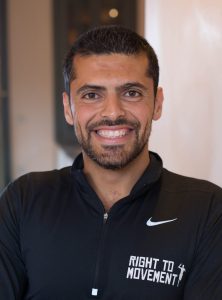
George Zeidan is the co-founder of Right to Movement Palestine, a social running group across nine Palestinian cities that uses sports as a tool to highlight the basic human right to freedom of movement and to promote a culture of acceptance for women’s sports.
The nonprofit was established in 2013 along with two Danish volunteers after Zeidan returned home to Palestine following university in the U.S. He had been interning at a human rights organization when one of his colleagues, a woman named Signe, suggested organizing a marathon in Palestine, as there were none that existed at the time.
“The idea came from the aim to do a project in Palestine that can work on changing the stereotypical image of Palestinians globally. I have myself been a student —I did my bachelor before that in North Carolina —I am aware and experienced how it is perceived to be a Palestinian, a person from the Middle East.”
The sport of running doesn’t require any fancy equipment, courts, or specific skills to participate. As such, it’s an inclusive and effective way to mobilize lots of people into supporting the cause.
“It’s pretty funny because there was no culture of what’s a marathon. You can run into somebody like, ‘Oh, I ran ten marathons,’ but basically, they’re talking about a two or three-mile race.”
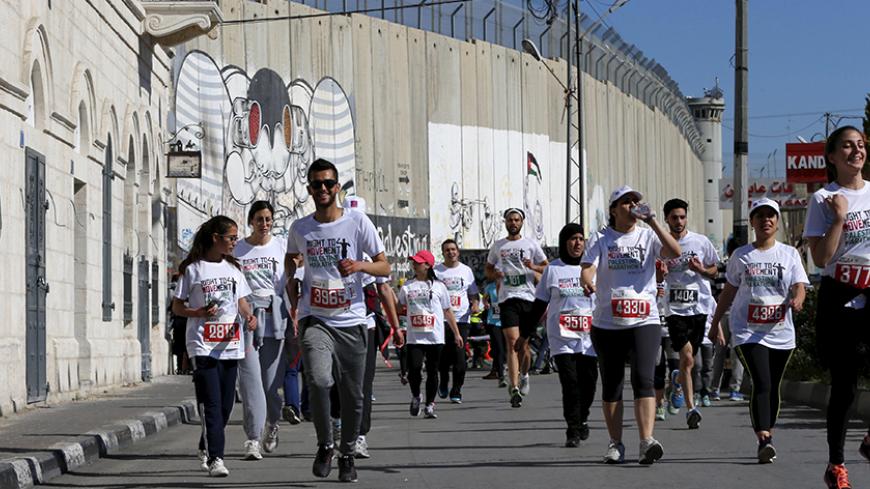
Zeidan and Signe sought the help of a company from Denmark that had the logistical experience of organizing a race. As such, the first ever marathon in Palestine was organized with an important message at its core. When trying to complete the 26-mile race in the city of Bethlehem, runners must do two loops of the same route to avoid Israeli settlements and checkpoints.
“We wanted to do a Bethlehem marathon and realized that the longest distance that you can have in area A under the Palestinian control is 10 kilometers. What we had to do to finish the race is you start from point A to point B and you go back to point A —and that is half a marathon. Then you have to do this all over again to finish your marathon, and that’s why we came up with the name Right to Movement.”
The idea behind the race was to promote running as a sport and raise awareness about the restrictions on Palestinians’ freedom of movement. Funded by participation fees and sponsors of companies who wanted to be part of the event, Run for Palestine organized the Palestinian marathon for four years, first starting in Bethlehem and then expanding to other cities. Its debut in 2013 featured 600 runners, while the most recent race had 4,600 runners.
“We are a volunteer group, self-sustained. The purpose of doing this is to do something happy and positive in Palestine amidst all the negative aspects of living under occupation — and also finding a platform to talk to people about the situation.”
In 2017, the Palestinian Authority took over the organization of the marathon; an article published by the Huffington Post documents it in detailed fashion. However, community running groups formed as a byproduct of the marathon continue to operate.
“We believe that the experience of running the Right to Movement Palestine marathon is the experience of living under occupation. It’s the same track that we use to go to school, it’s filled with the checkpoints, the apartheid wall, the settlement refugee camps. It’s the same thing that we use to go to work, to go to school, and it’s the same way we run. It resembles the reality of our everyday life and that’s why we find it a very powerful way of communicating to the world, and really to preach beyond the choir of people who know about what’s going on here.”
Additionally, Right to Movement also organizes environmental clean-ups and aims to foster a supportive environment around women’s sports in a region that hasn’t been as embracing.
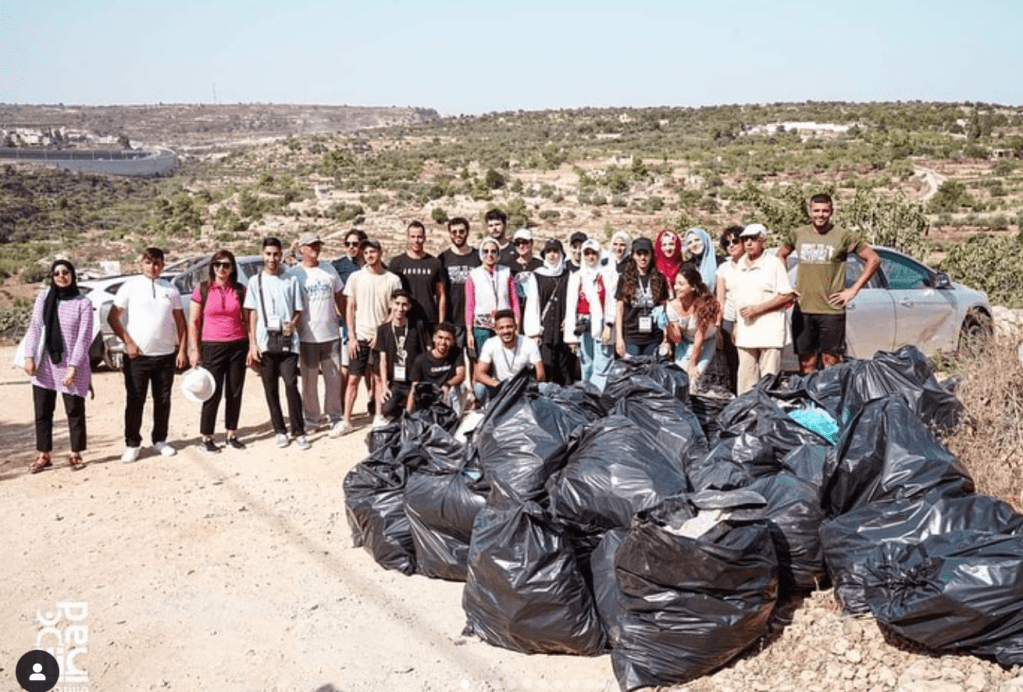
“A big focus for us has always been ‘How do we create this space for Palestinian women to be there and run with Palestinian men in equal numbers?’ How do we create that proper atmosphere for women to run and exercise?”
Connecting Palestinians across different regions:
One of the most interesting things about Right to Movement is how it enables Palestinians with different administrative statuses to share their unique experiences living in separate regions.
For instance, in the West Bank, Palestinians hold a Palestinian passport, go through a Palestinian education system, and require a permit to go to Israel. In Jerusalem, Palestinians are granted residency to be in Israel but don’t have the same rights as Israelis —and do not possess either Israeli or Palestinian nationality.
“Palestinians for example in Hebron would not have any chance to know any Palestinian in Haifa if it wasn’t for the group, and vice-versa. The administrative status that each one of us holds means that you perceive stuff differently than the others because your experience living under occupation is totally different than other Palestinians. And it’s always fascinating when we put everybody in the room and try to really merge or bridge these gaps and misunderstandings.”
Ensuring that the nuanced differences of such experiences are represented equally is of great importance to the organization.
“One of the things that we have been doing is participating in international sports events, so sending delegations that represent different Palestinians to run in different marathons around the world. And that is one of the ways that we kind of put the team together [in a way] that is equally represented both gender-wise and geographically… [We] try to really put people out there to kind of have this discussion, have this experience together.”
Engaging the international community, measuring the movement’s success
Zeidan measures Right to Movement Palestine’s success based on their ability to engage locals with their running groups and their capacity to engage the broader international community.
“In terms of local movements, we are perceived as one of the most important legitimate local movements in the country because of this grassroots element that we have —we are not funded by anybody, and we dictate what we do.”
Losing control of the marathon to the Palestinian Authority was a blow to their group, as it was their central event. As such, the nonprofit has pivoted their international mobilization by focusing on innovative advocacy campaigns, such as “Race to Recognize,” done in partnership with a U.S. congresswoman’s office and nonprofit Rebuilding Alliance with the objective of talking to tech giants about including Palestinian villages in their navigation.
Another example is their involvement with “Relay Run for Refugees,” a 250-mile-long race from NYC to DC organized in reaction to the Trump administration’s decision to defund UNRWA USA, a relief and human development agency for registered Palestine refugees.
Open dialogue and the limits of peacebuilding projects
With sports known for their unifying and escapist nature, the prospect of inserting sport in such a contentious context may cause one to feel discomfort.
After all, past attempts at peace negotiations have failed to bring a lasting solution to the Israel-Palestine conflict due to a combination of factors that include historical claims, political and economic interests, religious elements, and deep-seated distrust between the two sides. The international community generally considers the Israeli occupation of the West bank and Gaza Strip (until 2005) to be a breach of international law. Organizations such as Amnesty International, Harvard Law Review, and Human Rights Watch have stated that the threshold for apartheid has been crossed based on existing legal frameworks.
With these tensions in mind, Zeidan believes it’s naïve to think that sport can open the floor and act as a bridge in some capacity, particularly given the right-wing shift in Israeli leadership. He emphasizes that such projects have been tried many times, to no avail, and insists that his group refuses to become tokens, considering the recent rise of religious Zionism in Israeli society.
“I think there’s a lot of unlearning that needs to be done on how effective these projects are. We have seen these projects happen in Palestine among Palestinians and Israelis for many years now and there’s no reason to think that these projects can be scaled because they have not been scaled. And people do see what happens on the ground and people are not willing to compromise.”
However, Zeidan is of the view that the main value of Right to Movement lies in the group’s ability to open up dialogue for a Palestinian community that has been geographically divided as a result of the occupation, as well as alienated by its own authoritarian leadership.
“From a personal standpoint, and in our group, we really understand how dialogue is important and how a lack of dialogue is dangerous. We are aware of that, and we view our responsibility is to really create and maintain a dialogue between Palestinians themselves as a responsibility of our group.”
Moving forward/sport as a vehicle for change
Looking ahead, Zeidan has a couple goals laid out for Right to Movement Palestine. One of which is to elect the board of volunteers that will act as a council to manage the organization and create a sustainable model. Another objective is to continue to organize races in the future and build on top of the 20 campaigns that have been completed.
Zeidan is careful to assign short-term, measurable expectations for what his organization can reasonably achieve as a nonprofit, nonpolitical group.
“If I sit here and tell you, ‘I’m going to change the world, or the reality of Palestinian movements,’ are we going to change that? Probably not, but if we have short-term goals that can contribute towards positive trends in our society, I think that is a fair responsibility and fair expectation to have from a sports movement.”
“We have been able to reach a lot of people who wouldn’t necessarily know anything about Palestine and through sports have been able to engage with what happens here. I think it’s a legitimate theory of change.”
What is certain, however, is sport’s capacity to engage with the international community and humanize civilians caught in the middle of an intricate conflict, as well as the ability to provide Palestinians with a platform to band together amid mounting cynicism.
“I think of the sport of running as one of the ways to [humanize people] in the sense that it’s really able to engage everybody to become a player and not only to watch from far away or monitor. And I find that a powerful way to engage people with what’s happening here when you yourself have the experience.
 Elixir Sports