
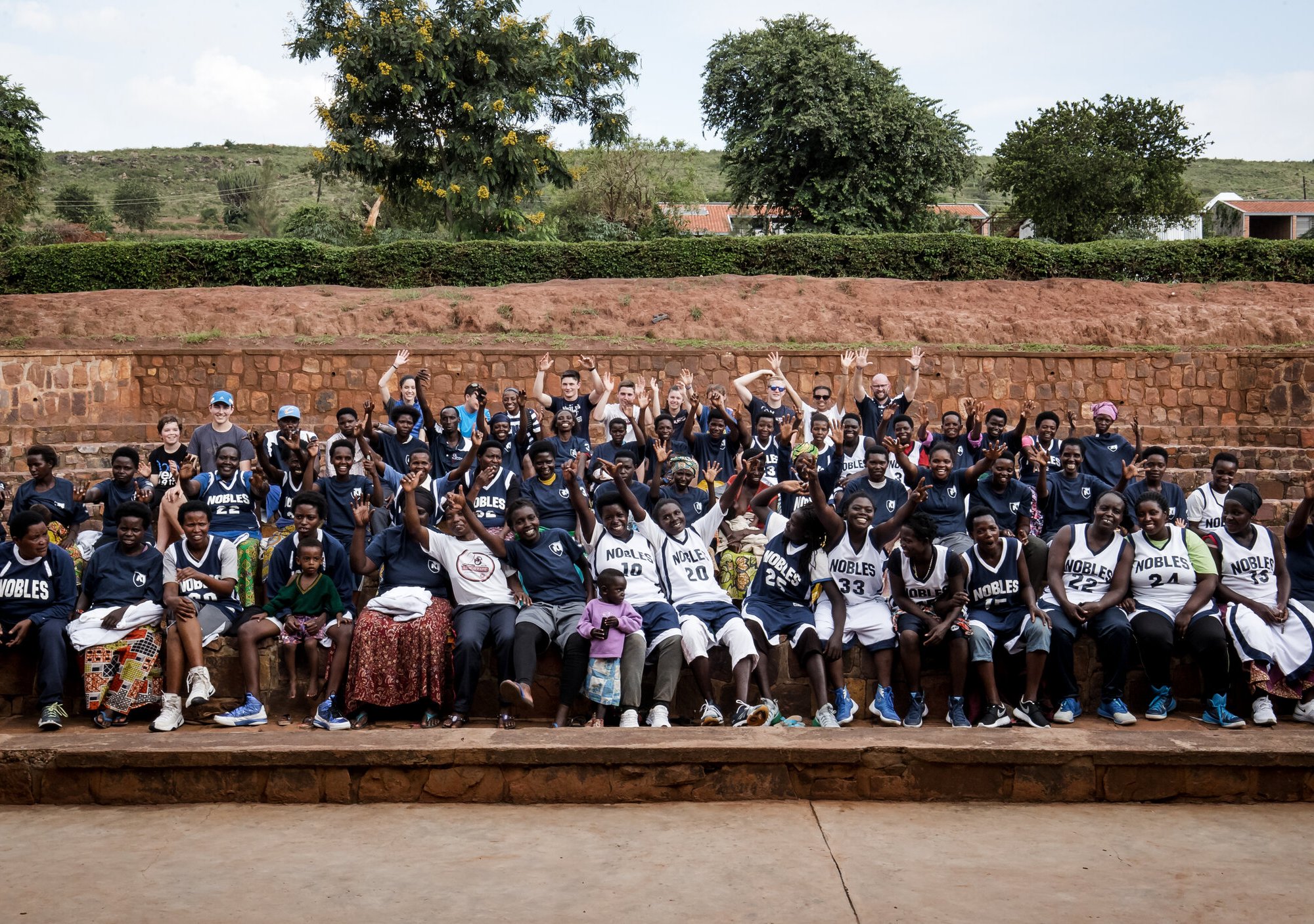
Photo Credits: @Shooting Touch Rwanda
The first edition of Elixir Sports’ Spotlight Series focuses on Shooting Touch, a remarkable sport-for-development organization that uses the mobilizing power of basketball to bridge opportunity gaps for youth and women in Boston and Rwanda. Since its inception in 2007, the nonprofit has impacted over 25,000 people worldwide through its outcome-driven programming. This feature will specifically concentrate on Shooting Touch’s efforts in Rwanda, though the Boston program certainly merits its own respective praise.
Shooting Touch Rwanda (STR) supports children and women living in the Eastern Province of Rwanda by using basketball as a platform to teach health education and promote gender equality by destigmatizing women’s participation in sports.
In rural Rwanda, poverty is prevalent and proper education is rarely affordable, forcing many children into farming and manual labor rather than into the classroom. The region is also haunted by one of the darkest chapters of the 20th century—the Rwandan genocide of 1994—which was perpetrated by ethnic Hutu extremists and led to an estimated one million people being killed.
Given this historical and present-day context, STR’s positive impact on Rwandan local communities and villages cannot be overstated. The nonprofit turns basketball courts into classrooms, health clinics, and community centers, guided by the leadership of its coaches, who operate as community mobilizers, social workers, and public health advocates. According to STR’s website, since 2016, over 14,000 health care sponsorships have been provided and, in coordination with community health workers, the organization has educated 64,000 people on the benefits of health insurance.
As part of its health education and intervention curriculum, Shooting Touch organizes community health events and provides gender equity programs, economic advancement opportunities, and mental health counseling.
On the basketball front, practices are held every day from 4 pm-7 pm across five court locations, with participants divided into four groups: women, children, boys under 18, and girls under 18. A staff of 15 Rwandan coaches now run the practices entirely by themselves, seven of whom are female.
To get a better understanding of STR’s day-to-day programming, I spoke with Won Jung, a Director of Operations fellow at Shooting Touch Rwanda. Before joining STR, Jung worked in community relations with the Washington Commanders and was involved in nonprofit management at the Boys & Girls Club of New Haven. Both of these experiences inspired him to join Shooting Touch, where he is now in charge of programmatic operations, strategy planning, and monitoring & evaluation.
Below is a transcription of my interview with Won Jung.
*Note: All answers are from Won Jung, and should be treated as such. They are not answers on behalf of Shooting Touch and do not speak for any other Shooting Touch staff members.
Could you talk about the success of Shooting Touch’s marquee basketball events?
WON JUNG: At Shooting Touch Rwanda, we host various events throughout the year to bring our beneficiaries together for a good time and basketball competition, to provide health testing and health education, and to raise awareness and provide education on important topics relevant to our mission. Our two annual marquee events are our Gender-Based Violence Awareness Basketball Tournament and International Women’s Day Celebration. At these events, we focus on themes of gender equity and good health, with speakers from our partner organizations and local governments, as well as health testing for NCDs and STI/STDs. These are great opportunities to bring together beneficiaries from all of our court locations throughout the Eastern Province and bear witness to the collective power of the Shooting Touch community. Over 1000+ beneficiaries and community members attended these two events in 2022 and nearly 1000 attendees were tested for NCDs and STI/STDs collectively. We also handed out over 1000 pamphlets with vital information pertaining to GBV, NCDs, and STI/STDs.
How does Shooting Touch secure partnerships and funding?
WON JUNG: I am not directly involved in the partnerships and funding aspect of Shooting Touch, but I will answer this to the best of my knowledge. On the partnerships side, Shooting Touch has cultivated relationships with key public and private stakeholders in the domestic and international sport-for-development and nonprofit sectors since its inception 15 years ago. With programs in Boston and Rwanda, Shooting Touch is uniquely leveraged to activate local, national, and international partnerships with not only major international brands such as the NBA, the IOC, Nike, FIBA, and Comic Relief, but also community-specific organizations like the Boston Police Department and Survivors Fund Rwanda, to name a few. Shooting Touch also engages with schools and universities, as well as private individuals who wish to further our mission. Through a mix of targeted outreach, inbound inquiries, and happenstance encounters, these partners connect with us to provide funding, in-kind donations, programmatic support, and so much more…which leads us to the funding side of things. Our funding is comprised of grants, corporate donations, individual donations, fundraising events, and specific fundraising campaigns, all of which are strategically procured to align with our values and support our work in the US and Rwanda.
What was the initial idea behind starting a women’s co-op program?
WON JUNG: The idea for a women’s co-op program, which Shooting Touch hopes to implement within the next year, arose organically as coaches at our courts noticed that women who were coming to practice together started to form their own co-ops outside of practice hours. As an organization that is incredibly dedicated to sustainability and self-sufficiency, Shooting Touch saw this as an opportunity to provide a more formal structure for its women to gain economic independence through the relationships they were building at Shooting Touch courts. On top of providing exercise through basketball practices and education through health lessons, we also cover health insurance for our beneficiaries, which is vitally important to the continued good health of our beneficiaries. But with a growing program, we cannot promise health coverage to all of our beneficiaries every year moving forward. That being said, we wanted to provide beneficiaries with the tools to form their own path toward earning an income that they can put towards covering their health insurance and other costs of living without the need for reliance on Shooting Touch. We hope to partner with local consultants to provide proper training and guidance to our co-ops.
Given the patriarchal context at play in rural Rwanda, have you experienced any tensions with some of the locals?
WON JUNG: In my experience, there is not a palpable tension with our push for gender equity in rural Rwanda but rather a dire need for the unlearning of patriarchal teachings and cultural norms that have been passed down for generations. One of the ways we encourage cultural change and continued discussion surrounding gender equity is not only by empowering women, but also by educating men about their role in the patriarchal system. Although we do not work with adult men on a daily basis, we invite them to our community events and even host family days at our courts to foster familial unity and gender equity as women and men compete together on the court. Often, our women beat their husbands and male counterparts in our mixed gender games! Sure, there will always be a loud minority that is strongly opposed to structural change at this level, but there appears to be a general openness to the notion of gender equity, though change occurs gradually and slowly.
How do you earn the trust of the local community and overcome cultural/language barriers?
WON JUNG: Earning the trust of any community is, in my estimation, a simple task, but never an easy one. For me, it comes down to meeting the community members where they are, really listening to what they have to say, and showing a humility to learn from them and give legitimacy to their thoughts. No one knows a community better than the members of that community, so to think that I, as a foreigner, could come in and know what’s best for them without humbling myself and really getting to understand and experience their triumphs and struggles would be a grave mistake. So, I ultimately spend a lot of time with the members of the community. I walk the streets they walk, eat at the restaurants they frequent, show up at their gatherings at local soccer matches or monthly community clean-up days (known as ‘umuganda’), and I show up for them, day after day. I show them that I trust them. It’s a labor of love to earn trust, and at the end of the day, it’s a privilege. So I treat it as such, and devote a great amount of effort and thought into consciously and sensitively embedding myself into the community to gain its trust.
As a fellow, does it ever get a little bit heavy, given the country’s past and present realities ?
WON JUNG: To be completely honest, on the day-to-day, it doesn’t. The people are perpetually joyous and the days are astonishingly simple. But every time I take a step back and take stock of where I am and how I am even able to be here, I am in awe of the tremendous progress that Rwanda has made. Of course, it’s not all sunshine and roses; the ever-present reality of the omnipresent issues of daily life are inescapable. But, to think that 28 years ago this country was torn apart by genocide and civil war and now is one of the safest and most peaceful places on the continent…it’s quite simply a miracle. I would be remiss not to mention the many freedoms that have to be sacrificed on a daily basis and the questionable track record of the President with regard to political dissidents, but looking around the region, it’s easy to see why the Rwandese are quite happy and proud to be from Rwanda.
You can stay up to date with Shooting Touch by following their socials:
https://www.instagram.com/shootingtouch/
 Elixir Sports
Très bonne interview: bonnes questions et bonne introduction. Bravo!
>
LikeLiked by 1 person
Merci beaucoup!
LikeLike
What an interesting and important initiative! Thanks for highlighting such an impactful organization.
LikeLiked by 1 person
Thank you!
LikeLike