
Preface
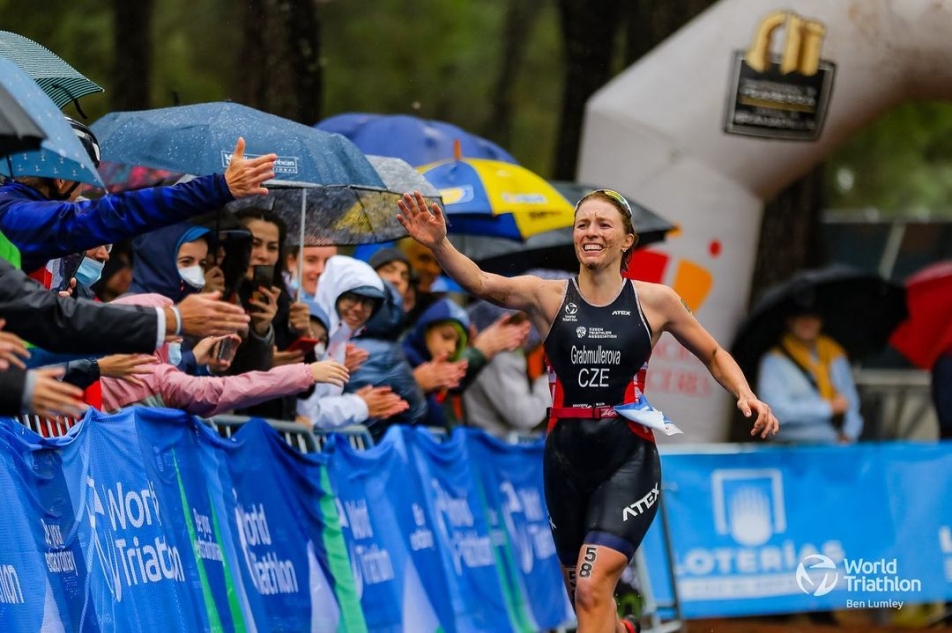
For the third edition of the Elixir Sports Spotlight Series, I had the pleasure to speak with IOC (International Olympic Committee) Young Leader and triathlete Aneta Grabmüllerova.
In our conversation, we dive into Aneta’s triathlon career, her battle with RED-S (Relative Energy Deficiency in Sport), and the project she is currently building to prevent other young women in sport from enduring the same battles. We additionally cover Aneta’s post-graduate research focusing on gender in sports communication.
Intro
Growing up in the Czech Republic, Aneta Grabmüllerova became immersed in the world of triathlon when her parents began to compete in the sport in the late 90s.
“I grew up in the triathlon environment and I fell in love with the sport and its community. It was just natural that I competed from a very early age as well.”
Triathlon is a pastime for the strong-willed. It is a multi-disciplinary event whose origins trace back to the early 20thcentury, consisting of swimming, cycling, and running. There are different types of races broken down into four basic distances: Sprint, Olympic, Half Iron, and Ironman.
Aneta would go on to experience success on a global stage over the course of her 15-year career as a professional triathlete. Her notable achievements include becoming a two-time Junior World Champion in the winter triathlon, and winning the 2016 World U23 Cross Triathlon World Championships.
However, Aneta’s proudest accomplishment was winning the bronze medal at the 2021 Triathlon World Championships. While she may not have stood on top of the podium, as she had done in the past, the medal signified a personal triumph because Aneta, at numerous points, was left wondering if she would ever compete again.
The Unnecessary Cost of Success- Aneta’s Battle with RED-S
Aneta may have been at the top of her game, but all was not well beneath the surface. She began to suffer physical pain when her coach incessantly compelled her to lose weight, believing it would improve her performance.
“I was told that I gained weight and I need to lose some weight to look a certain way, to perform better. And that was repeated over and over and over […] and it resulted in a lot of suffering— and eventually retirement at an early age (21).
The combination of Aneta’s extreme training regimen and under fueling led her to develop a syndrome called RED-S, or Relative Energy Deficiency in Sport. RED-S is the result of insufficient caloric intake and/or excessive energy expenditure. In other words, the body isn’t taking in enough energy to meet the demands placed on it by the amount of exercise being performed. In addition to peak athletic performance being compromised, the lacking energy can negatively affect critical body functions, such as menstrual disturbance, disordered eating, and low bone density.
While her former coach’s ignorance about nutrition merits blame, sports science research is generally conducted on male participants, leaving out critical insights about the specifics of female training.
“We know very little about, for example, how female athletes are affected by their periods, how to adjust their training based on where they are in the cycle […] and the little we learn, most of the coaches ignore anyway. I think, only now we [are starting] to take that into consideration.”
The decision of Aneta’s coaches to ignore her pleas of help led her to develop serious long-term effects: “They encouraged me to take painkillers to compete, and this is so wrong. This is just so wrong —our health is not taken into consideration, not in the short-term and not in the long-term — because the consequences of living years with relative energy deficiency (RED-S) can have a lifelong consequence. It has now been eight years since I’ve retired, then two years since I came back to triathlon, and I am still having health consequences.”
I told Aneta that her story reminded me of the Nike Oregon Project scandal involving professional middle-distance runner Mary Cain, which sent shockwaves across the US sports ecosystem. Her coach, Alberto Salazar, allegedly emotionally abused her and obsessed over her weight, leading Cain to develop an eating disorder, generalized anxiety, and post-traumatic stress syndrome.
Of course, Aneta was aware of the incident, noting that many young female athletes silently go through the journey.
“And she is not the only one, you know. There are so many stories like that, and I would say we know about those that sort of had a happy ending: others who recovered and got out of it somehow and made it back, like me. But there are so many of those stories that we don’t know about, those athletes that had to retire when they were 18, 19, 20 before they could achieve anything because their mental or physical health is just destroyed.”
Aneta’s IOC Young Leaders Project
Aneta is among the 25 IOC Young Leaders who receive funding from the International Olympic Committee to create a sport-based social business that align with sustainable development goals.
Aneta’s inspiration for her project came about when she began to receive lots of questions pertaining to what she had endured after publicly sharing her experience on social media. While she was able to provide anecdotal advice drawing from her past, Aneta quickly noticed a glaring problem:
“I realized there is no resource, there is no website, there is no institution where I could send those people. I realized we need information, a website where those people will find help. Their knowledge of English in the Czech Republic is quite low— there are very good resources in English— but we need to have that in Czech language, especially for the older generation of parents and coaches.
Aneta’s is now developing a digital platform that will provide information for parents, coaches, and medical staff about RED-S. She has partnered up with researchers from universities in the Czech Republic doing work on RED-S and nutrition for athletes. With their support, her website will offer a chat with specialists, a nutritional therapist, and psychologist. Her goal is to also incorporate e-learning platforms providing lectures about the specific topics.
She additionally has the backing of the Czech Triathlon Association, as she will give talks at camps to share her knowledge.
“When I started to seek answers to my problems, when I lost my period, when I had a stress fracture, I went to different doctors, but nobody told me that it is related to under fueling, not eating. Every single doctor told me a different answer and treated different symptoms, but nobody connected it to sport and eating. I see that as a fundamental problem. We need to educate doctors about this problem because that’s the first contact for those athletes.”
Sports Communication Research– How Female Athletes are Represented in Media
In addition to her background in triathlon and her work in RED-S, Aneta is channeling her passion for helping women in sport through her post-graduate research. She already has a Master’s in Sports Management from Molde University College in Norway and is currently a PhD candidate at the University of Bergen and Kristiania University College in Oslo.
For her Master thesis, Aneta wrote about gender in sports communication and is continuing to pursue that subject for her PhD. She is researching what NOCs (National Olympic Committees) and the IOC are doing to improve gender equality and women’s empowerment through media outlets.
It is well documented that female athletes are underrepresented in media coverage compared to their male counterparts, except during certain events like the Olympics. It’s also known that the financial incentives of sports journalism have long justified men’s domination of media coverage, thus eschewing the responsibility of promoting women’s sports.
“Media will often tell you ‘We don’t have the responsibility to cover this because we respond to the demands,’ but at the same time they are the one that can create the demand.”
Her latest publication, “Social Media and the Olympics: A Chance for Improving Gender Equality,” draws upon a quantitative analysis of social media accounts of three NOCs (Norway, Czech Republic, and Switzerland) and qualitative in-depth interviews with their social media personnel.
Her results found that the NOCs dedicated fair amount of content dedicated to female athletes with an emphasis on their participation and success. Her quantitative findings in the interviews identified three key principles for supporting gender equality: individual agency (role of gatekeepers), living up to Olympic values (organizational role), and social responsibility.
For instance, as opposed to news media, the IOC’s own media production is not a primary source of finance. As such, the NOCs’ media personnel don’t need to follow the incentives of engagement and likes, and can instead equally portray a broad range of athletes across different sports.
Aneta is optimistic about the considerable strides that have been made regarding the increased airtime dedicated to women’s sports. However, she believes that female athletes have a ways to go before fully reaping the financial rewards of their talents.
“Not only do we receive, in most cases, lower prize money, but we also have much lower chances to be sponsored. For example, triathlon is one of the most equal sports in the sense that, at the Olympics, we get equal participation, prize money, we have events at the same time, basically the same TV coverage. All of that’s great, but when you compare how much money female athletes and male athletes get from sponsors and have a chance to earn, that’s incomparable. I don’t really have a solution for that, I think brands just need to realize that there is 50% of women in the world […] if they target women, they also will earn more.”
Looking Ahead
Aneta’s story is bittersweet, as it’s the tale of an individual who accomplished their childhood dreams of athletic success at the expense of their wellbeing.
I asked Aneta whether she looks back on her accomplishments with pride, given the health-related repercussions.
“I still have health consequences, and I’ve been thinking about it a lot lately. I have to say, I would exchange all my medals for being healthy. Obviously, those medals mean a lot to me, and I don’t regret being a professional triathlete. It brought me a lot of good things, a lot of good memories, lot of personalities, it brought me into the place I’m right now—and that’s a very happy place. But it cost me a lot, and perhaps I wished that I knew how much it would cost. I wished I could do things differently — and it’s a huge motivation for my project because I don’t want anyone to go through what I went through. I hope that I can raise awareness and I can prevent it because that’s not a price that athletes should pay for any success.”
Aneta’s bronze medal at the 2021 Triathlon World Championships two years after returning to the sport was proof that she could achieve success and control her legacy on her own terms. With the support of the IOC, she will continue to help younger female athletes overcome obstacles in the early stages of their sporting careers to ensure their success, and more importantly, their health.
 Elixir Sports
Aneta exemplifies the will to transform a personal painful experience into a positive action impacting many people and creating a change. Her research is promising.
LikeLike